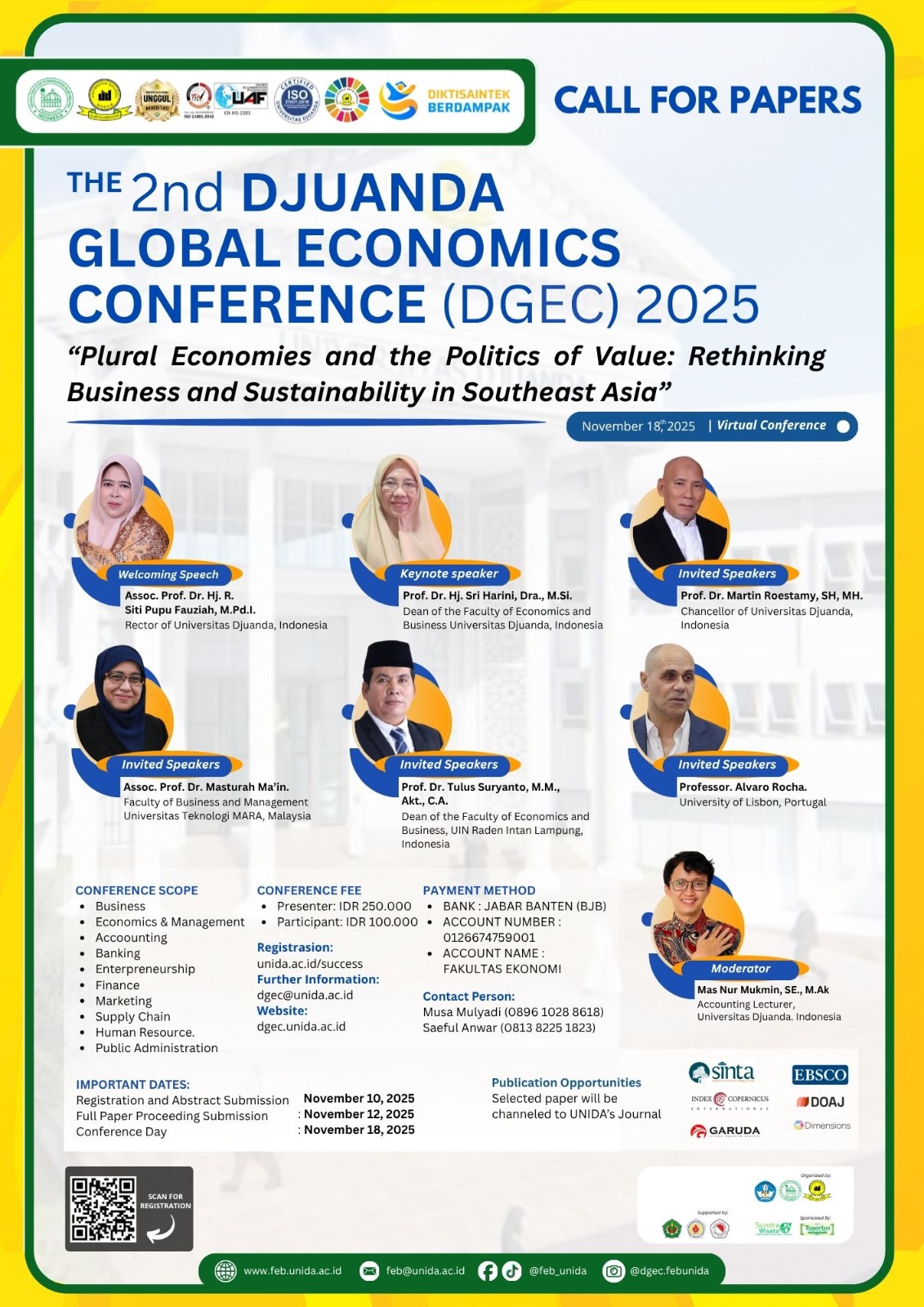
Plural Economies and the politics of value: Rethintking Business and Sustainability in southeast Asia
Conference Chair : Saepul Anwar, S.Ak., M.Ak
A.Background
Global economic development continues to undergo dynamic changes influenced by various factors, ranging from technological disruption and sustainability issues to geopolitical dynamics. Indonesia, as a developing country with vast economic potential, plays a crucial role in promoting the creation of a more stable and inclusive global economic order.
In the rapidly transforming landscapes of Southeast Asia, questions of sustainability, growth, and social well being intersect in complex ways. Conventional approaches to business and development often privilege singular economic models those that emphasize efficiency, profit maximization, and standardized measures of success. Yet, lived realities across the region reveal a far richer and more diverse spectrum of economic practices, from community-based cooperatives and informal market exchanges to faith driven enterprises and digitally enabled micro-businesses. These plural economies challenge the dominance of mainstream frameworks and open up alternative pathways for imagining value, prosperity, and sustainability.
The Djuanda Global Economic Conference (DGEC) 2025 is organized as an international scientific platform that brings together academics, researchers, policymakers, and practitioners from various countries. Its purpose is to discuss, analyze, and formulate innovative solutions to current global economic issues in line with the selected theme. This conference is expected to make a real contribution to the development of economic science and the formulation of more effective policies at both national and international levels.
The theme “Plural Economies and the Politics of Value: Rethinking Business and Sustainability in Southeast Asia” was chosen for its strong relevance to the current conditions of the region, including Indonesia. Socio-economic realities show that economic practices in Southeast Asia are not limited to formal profit-oriented models but also include cooperatives, informal markets, community-based enterprises, and entrepreneurship shaped by cultural and religious values. This diversity of practices constitutes plural economies, which challenge mainstream frameworks and open opportunities to redefine concepts of value, prosperity, and sustainability.
Furthermore, the conference serves as a forum to reflect on the politics of value underlying every economic activity: whose values are prioritized, who defines success, and how cultural, ecological, and social contexts shape the meaning of development. By focusing on these issues, DGEC 2025 is expected to generate new perspectives in understanding the role of business and public policy, while also contributing significantly to efforts in realizing sustainable development and the vision of Indonesia Emas 2045
B. Purpose of the conference
1. Providing a Scientific Forum: To serve as a platform for researchers and academics to present original research on global economic issues.
2. Encouraging Collaboration: To facilitate the exchange of ideas, experiences, and research collaborations among participants from various institutions and countries.
3. Disseminating Knowledge: To share the latest findings and best practices in the field of economics with the public and policymakers.
4. Enhancing Institutional Reputation: To strengthen the reputation of the organizing institution in the international academic arena.
5. Supporting Economic Development: To generate policy recommendations that can be applied to accelerate inclusive and sustainable economic transformation
C. Format Conference
DGEC 2025 will be organized in the following formats:
1. Keynote Speech & Plenary Session: Presentations by key figures (economic experts, ministers, or leaders of international organizations) addressing the main theme.
2. Parallel Sessions (Call for Papers): Academic and research paper presentations by selected participants.
3. Panel Discussions: In-depth discussions with experts on specific topics.
4. Publication Opportunity: Selected papers will have the opportunity to be published in international journals or indexed proceedings (e.g., Scopus, Web of Science, SINTA).
D. Conference Scope
1. Business Scope
2. Economics & Management
3. Accounting
4. Banking
5. Enterpreneurship
6. Finance
7. Marketing
8. Supply Chain
9. Human Resource
10. Public Administration
E. Target Participants
1. Academics and Lecturers
2. Researchers and Postgraduate Students
3. Business and Industry Practitioners
4. Policymakers from Government Institutions
5. Representatives of International Organizations
F. Speakers and Participants
Djuanda Global Economic Conference, was held by involving several speakers as follows:
Welcome Speech :
Dr. Hj. R. Siti Pupu Fauziah, S.Pdi. M.Pd.i (Rector of Universitas Djuanda, Bogor, Indonesia)
Keynote Speakers :
Prof. Dr. Sri Harini, Dra, M.Si (Dean of the Faculty of Economics and Business, Djuanda University, Bogor, Indonesia)
Invited Speakers :
Prof. Dr. H. Martin Roestamy, S.H., M.H (Cancellor of Djuanda University, Bogor, Indonesia)
Assoc. Prof. Dr Masturah Ma’in (Faculty of Business and Management UiTM Cawangan Selangor
Proffesor Alvaro Rocha (University of Lisbon, Portugal)
Moderator:
Masnur Mukmin, SE., M.Ak (Accounting Lecturer, Universitas Djuanda, Bogor, Indonesia)
G. Time and place
The Conference activity will be held on:
Day : Tuesday
Date : November 18, 2025
Time : 08.00 -15.20 (WIB)
Venue : Virtual Zoom
Link :
H. Conference Fee
Presenter: IDR 250
Participant: IDR 100
Payment Method
BANK JABAR BANTEN (BJB)
ACCOUNT NUMBER : 126674759001
ACCOUNT NAME : FAKULTAS EKONOMI