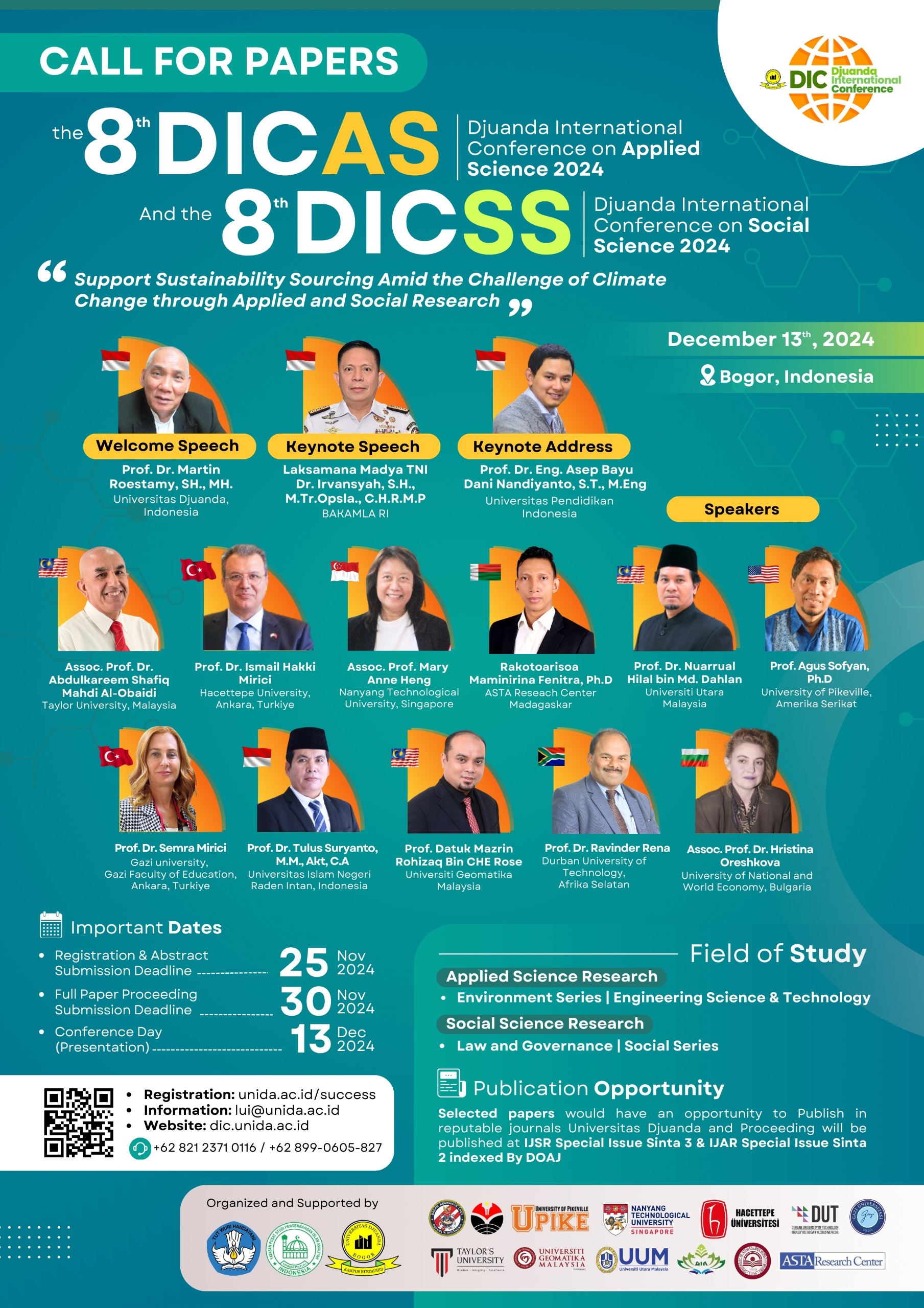
Support Sustainability Sourcing Amid the Challenge of Climate Change through Networking and Collaboration in Applied and Social Research
Conference Chair : Prof. Dr. Rasmitadila, M.Pd.
Registration System
Universitas Djuanda developed its own Conference Registration System. All registration process could be updated through the system. We ensure the conferences are accessible for worldwide participants. https://unida.ac.id/success
Overview
The 8th Djuanda International Conference Social Sciences (DICSS) and The 8th Djuanda International Conference on Social Sciences (DICSS) is an annual seminar series organized by Universitas Djuanda, Bogor, that promotes the integration of academic and professional research within the framework of Tawheed (monotheism) and the United Nations Sustainable Development Goals (SDGs). Each year, the conference addresses pressing global issues, aiming to foster dialogue, collaboration, and solutions.
Objective
The main objective of the 8th Djuanda International Conference on Applied Sciences (DICAS) and The 8th Djuanda International Conference on Social Sciences (DICSS) is to provide a global platform for interdisciplinary collaboration, dialogue, and knowledge sharing to address the challenges of sustainability sourcing in the context of climate change. By aligning the conference discussions with the principles of Tawheed and the Sustainable Development Goals (SDGs),
Specific SDGs highlighted in the conference:
Goal 1: No Poverty
Goal 4: Quality Education
Goal 5: Gender Equality
Goal 16: Peace, Justice, and Strong Institutions
Goal 17: Partnerships for the Goals
Important Dates
Venue : Universitas Djuanda, Bogor Indonesia
Registration & Abstract Submission Deadline: 25 November 2024
Notification and Payment Deadline: 25 November 2024
Full Paper Proceeding Submission Deadline: 30 November 2024
Conference Day (Presentation) : 13 December 2024
Scope of The Conference
Applied Sciences Research: Solutions for sustainability sourcing amid the challenges of climate change.
Social Sciences Research: Exploring the role of social research in addressing climate change and sustainability goals