Social and Political Transformations for Sustainable Development
Conference Chair : Assoc. Prof. Dr. Rita Rahmawati, Dra., M.Si.
Conference Overview
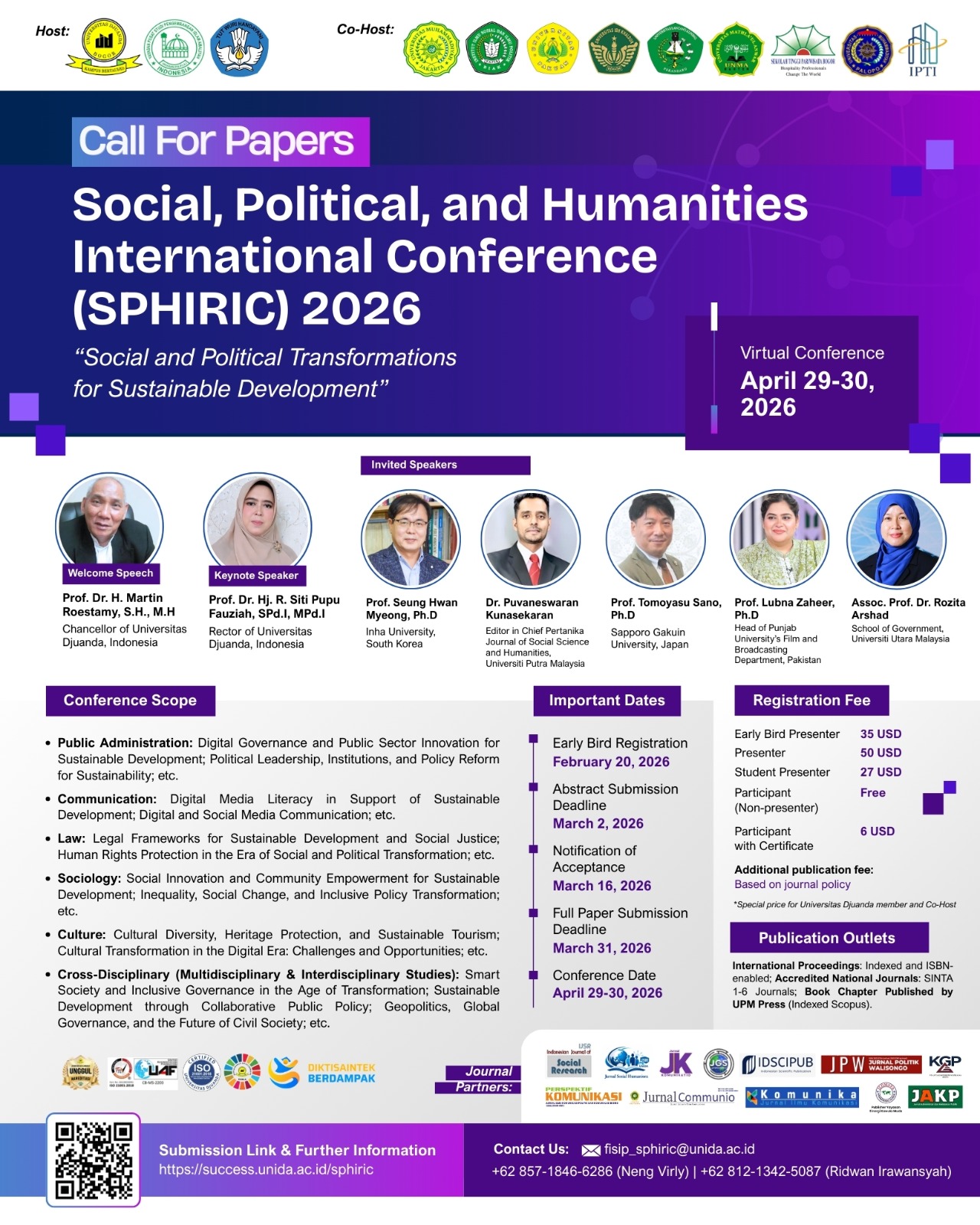
SPHIRIC (Social, Political, and Humanities International Conference) is an international scientific forum that brings together academics, policymakers, practitioners, and stakeholders across sectors to discuss social and political transformations in the context of sustainable development. The conference, titled "Social and Political Transformations for Sustainable Development," will be held on April 29-30, 2026, at Djuanda University in Bogor, Indonesia, in online format. This event is organized by the Faculty of Social and Political Sciences.
Background
The conference is motivated by rapid, complex global changes driven by technological advances, demographic shifts, environmental challenges, and evolving governance structures, which impact the design and implementation of sustainable development policies. At the same time, the world faces issues such as climate change, social inequality, political polarization, and digital disruption, which require innovative governance approaches to balance economic growth, environmental protection, and social justice. Socio-political transformation is crucial for achieving the SDGs, requiring changes in institutions, public participation, community empowerment, and policy innovation that are inclusive, transparent, and resilient.
Conference Objectives
The conference aims to facilitate academic and policy dialogue between researchers, policymakers, practitioners, and international organizations. These discussions will focus on the dynamics of social and political transformation. The event also fosters interdisciplinary understanding by integrating perspectives from public administration, political science, sociology, environmental studies, economics, and technology. SPHIRIC aims to strengthen global-regional collaboration and identify sustainable development strategies, such as innovative governance models and digital transformation. The conference also supports knowledge dissemination through proceedings, journals, and collaborative networks.
Target Participants and Outputs
The target participants include academics/researchers, government officials/policymakers, practitioners from NGOs/international organizations/development institutions, the private sector, postgraduate and doctoral students, and community/social movement leaders. Expected outputs include increased scientific understanding, policy recommendations for inclusive and sustainable governance, strengthened collaborative networks (research/publication/exchange), and publication of proceedings or selected articles in relevant publication channels.
Target Audience
a. The SPHIRIC Conference is designed as a multi-stakeholder forum. Participants, both in person and online, will consist of the following groups:
b. Academics & Researchers: University lecturers and researchers seeking new theories and methodologies.
c. Policymakers: Government officials seeking practical insights for policy formulation.
d. Practitioners & NGOs: Representatives of organizations focused on program implementation.
e. Students: Undergraduate and Master's students researching related fields.
Sub Theme
Conference sub-themes aligned with the theme 'Social and Political Transformations for Sustainable Development' are listed below for speakers to choose based on expertise:
A. Public Administration
1. Digital Governance and Public Sector Innovation for Sustainable Development;
2. Political Leadership; Institutions; and Policy Reform for Sustainability;
3. Climate Governance and Environmental Policy Innovation;
4. Sustainable Economic Transformation and Investment Policy;
5. Smart Cities, Smart Villages, and Sustainable Urban–Rural Linkages;
6. Smart Governance; E-Government; and Sustainable Public Services;
7. Global Cooperation; Governance Networks; and the Future of Sustainable Development;
8. Collaborative Governance and Public Participation for the SDGs;
9. Decentralization; Regional Autonomy; and Development Inequality;
10. Institutional Capacity and Public Leadership in Social Transformation;
B. Communication
1. Digital Media Literacy in Support of Sustainable Development;
2. Digital and Social Media Communication;
3. Communication Technology, Citizen Engagement, and Participatory Development;
4. Strategic Communication for Social and Political Transformation;
5. Risk Communication and Crisis Management in Sustainable Development;
6. Intercultural Communication in the Global Era;
7. Family and Mental Health Communication;
8. Community Empowerment for Social Change Through Digital Communication;
9. Media, Disinformation, and the Challenges of Sustainable Development;
10. Political Communication Transformation and Digital Democracy;
C. Law
1. Legal Frameworks for Sustainable Development and Social Justice;
2. Human Rights Protection in the Era of Social and Political Transformation;
3. Regulatory Challenges for Digital Governance and Smart Societies;
4. Environmental Law, Climate Change Policy, and Community Rights;
5. Law Enforcement, Transparency, and Anti-Corruption in Democratic Governance;
6. Legal and Policy Transformation for Sustainable Development;
7. Law in Natural Resource Governance;
8. Regulatory Reform in Support of Social and Economic Inclusion;
9. Good Governance, Rule of Law, and Anti-Corruption;
10. Law and Technology: Regulatory Challenges in the Digital Age;
D. Sociology
1. Social Innovation and Community Empowerment for Sustainable Development;
2. Inequality, Social Change, and Inclusive Policy Transformation;
3. Sociology of Digital Society: Identities, Networks, and Power Dynamics;
4. Urban and Rural Transformation in Achieving Sustainable Communities;
5. Community Empowerment and Grassroots Movements in Sustainable Development;
6. Conflict Resolution, Peacebuilding, and Sustainable Societies;
7. Social Structural Change and Inequality in Sustainable Development;
8. Social Capital, Community Participation, and Community Resilience;
9. Urbanization, Rural Transformation, and Inclusive Development;
10. Social Movements and Public Policy Change;
E. Culture
1. Cultural Diversity, Heritage Protection, and Sustainable Tourism;
2. Cultural Transformation in the Digital Era: Challenges and Opportunities;
3. Local Wisdom and Indigenous Knowledge for Sustainable Development;
4. Arts, Creative Economy, and Cultural Innovation in Social Change;
5. Intercultural Dialogue, Social Cohesion, and Peacebuilding;
6. Local Culture and Local Wisdom in Sustainable Development;
7. Transformation of Cultural Values Amidst Social and Political Change;
8. Culture, Identity, and Global Cultural Diplomacy;
9. Preserving Cultural Heritage in Context: Modern Development;
10. Creative Industries, Culture, and the Sustainable Economy;
F. Cross-Disciplinary (Multidisciplinary & Interdisciplinary Studies)
1. Smart Society and Inclusive Governance in the Age of Transformation;
2. Sustainable Development through Collaborative Public Policy;
3. Geopolitics, Global Governance, and the Future of Civil Society;
4. AI, Ethics, and the Transformation of Social–Political Life;
5. Community Resilience and Disaster Governance in Sustainable Futures;
6. A Multidisciplinary Approach to Achieving Sustainable Development Goals;
7. Integrating Policy, Social, Cultural, and Technological Issues for Sustainability;
8. Socio-Political Transformation in the Context of Climate Change;
9. Social Innovation and Sustainable Development Models;
10. Community-Based Development and Cross-Sector Collaboration;
Reviewer:
1. Dr. Muhamad Husein Maruapey, MSc (Universitas Djuanda, ID Scopus: 59511230600)
2. Dr. R. Oetje Subagdja, SP., M.Si (Universitas Djuanda, ID Scopus: 57219940758)
3. Dr. Saprudin, S.Sos., M.Si (Universitas Djuanda, id scopus)
4. Dr. H. Muhammad Luthfie, Drs., M.Si (Universitas Djuanda, id scopus)
5. Prof. Dr. Agustina M. Purnomo, SP., M.Si (Universitas Djuanda, ID Scopus: 58541960300)
6. Prof. Novel Anak Lyndon ( Universiti Kenangsaan Malaysia, ID scopus: 48561494600)
7. Prof. Rasmitadilla (Universitas Djuanda, ID scopus: 57207115932)
8. Prof Widyasari (Universitas Ibnu Khaldun, ID scopus: 57209457518)
9. Dr.Ipik Permana., S.IP., M.Si., CME, (Universitas Sunan Gunung Jati, ID scopus: 60225328100)
10. Dr. IIS RISTIANI, S.Pd., M.Pd, (Universitas Suryakencana, ID scopus: 57216883448)
11. Dendy Rosman, BHospMgmt., M.Buss (Acc), (ID scopus : 57280668900)
12. Dr. Nindyta Aisyah Dwityas, S.Ikom., M.Si, (Institut Pariwisata Tedja Indonesia, ID scopus: 57205103726)
13. Nurul Sukma Lestari, (Institut Pariwisata Tedja Indonesia, ID scopus: 57205497288)
Location Details
Venue: Online
Important Date
- Early Bird Registration : 20 Februari 2026
- Abstract Submission Deadline : 25 March 2026
- Notification of Acceptance : 16 March 2026
- Full Paper Submission Deadline : 31 March 2026
- Conference Date : 29-30 April, 2026
Registration Fees
- Early bird Presenter : 35 USD
- Presenter : 50 USD
- Student Presenter : 27 USD
- Participant (Non-presenter) : Free
- Participant with certificate : 6 USD
- Additional publication fee: Based on journal policy
*Special price for Universitas Djuanda member and Co-Host.
Publication Outlets
This information is important for speakers to understand the forum's academic quality standards and where their manuscripts (if submitted as full papers) will be directed:
1. International Proceedings (ISBN-enabled)
2. Accredited National Journals: SINTA 1-6 Journals (such as:
a. Journal Governansi (Universitas Djuanda, Sinta 4)
b. Komunikatio, (Universitas Djuanda, Sinta 3)
c. Sosial Humaniora (Universitas Djuanda, Sinta 4)
d. Jurnal Communio (Universitas Nusa Cendana, Sinta 3)
e. Jurnal Perspektif Komunikasi (Universitas Muhammadiyah Jakarta, Sinta 2)
f. Indonesian Journal of Social Research (Universitas Djuanda, Sinta 2)
g. Jurnal Ilmu Komunikasi KOMUNIKA (Universitas Muhammadiyah Professor Doktor Hamka, Sinta 4)
h. Jurnal Politik Walisongo (Universitas Islam Negeri Walisongo Semarang, Sinta)
3. Book Chapter publishing by UPM Press (Indexed Scopus) APC 200 USD
4. Ilomata International Journal (Sinta 3)
Host:

Co-Host:

Journal Partners: